
|
Program Dates
|
Venue/Deadline IIMB Campus
Early Bird Deadline: 5 Nov 2026
Register By: 16 Nov 2026 |
Program Fees (excluding GST) Residential: Rs. 106500 |
Apply Now |
The programme is delivered in person and is designed to be highly interactive, practice-oriented, and grounded in real business contexts
This program is designed for professionals who are directly or indirectly involved in innovation, technology, strategy, and commercialization decisions, and who must engage with intellectual property as a strategic business asset rather than merely a legal formality.
Typical participant profile (10+ years of experience):
Ms. Vinitha Vandana
Landline No.:+91-80-26993475
Mobile No. +91-8951974078
Email: vinitha.vandana@iimb.ac.in
Programme Overview
We live in the knowledge economy – an era where knowledge is the primary input, knowledge is the process, and knowledge itself is the output. Increasingly, what we consume are not products, but intellectual property embedded within them.
Consider your favourite companies. Strip away their physical assets and ask: what truly creates value? Almost without exception, the answer lies in intangibles – algorithms, designs, software, data, patents, brands, trade secrets, and proprietary know-how. These invisible assets shape customer experience, confer competitive advantage, and today account for as much as 85 – 90% of a firm’s market valuation.
Suzanne and Sullivan (2012), in Edison in the Boardroom — Revisited, capture this historic shift by documenting how corporate value has steadily migrated from tangible assets – land, plant, and machinery – to intellectual assets such as formulas, specifications, technical know-how, patents, copyrights, designs, software, and brand equity.
Yet, despite their dominance, intellectual property assets are often poorly understood, weakly governed, and strategically under-leveraged. Firms routinely own IP without fully understanding how to defend, deploy, monetize, or strategically interact around it.
This executive program approaches intellectual property not merely as a legal construct, but as a strategic asset shaped by incentives, competition, and games. Through a game-theoretic lens, participants will explore how firms create, protect, signal, share, and contest IP — and how smart strategies around IP can determine who wins, who imitates, and who gets locked out of the game.
Programme Content
The program equips participants with the legal, economic, and strategic foundations required to leverage intellectual property in complex business environments.
It begins with the theoretical foundations of intellectual property, including utilitarian theory, the structure of IP rights systems, the concept of innovation, and principles of exclusion and value capture — clarifying how and why IP creates economic value.
The program then examines patents as strategic assets, covering the patenting process, legal definitions, infringement and remedies, and the practical skill of reading and interpreting patent claims. Key infringement cases illustrate how courts assess non-obviousness and inventive step, and why these interpretations matter for business decisions.
Participants learn to use patent information as a strategic tool, focusing on identifying, extracting, and interpreting patent data for technology and competitive intelligence. This includes patent data analytics, different types of patent maps, how to construct them, and how to derive actionable insights for innovation and business management.
The program also addresses design protection, including product design, non-functional aesthetic protection, registration processes, infringement standards, and leading cases.
A core differentiator is the integration of business negotiations and game theory, enabling participants to analyze strategic interactions around IP – licensing, bargaining, signaling, and deterrence – using real data and decision frameworks.
Through freedom-to-operate analysis, participants learn how firms assess and mitigate patent risks, supported by case studies of how leading companies combine legal, technological, and business strategies to avoid competitive blind spots.
The program further covers patent and design licensing, focusing on key contractual elements such as negotiation structure, warranties, indemnities, liabilities, and dispute resolution.
Beyond patents, it introduces trade secrets, trademarks, and geographical indications, including the role of trade dress, as well as plant variety protection and semiconductor design and layout protection, with particular relevance to India’s agricultural and technology sectors.
The program concludes with technology business incubation in India, examining incubation models, technology assimilation, and B2B collaboration between startups and large firms.
Key Benefits/Takeaways
This program enables participants to move from IP awareness to IP advantage. It equips leaders with the ability to interpret, evaluate, and deploy intellectual property as a strategic asset that directly influences innovation outcomes, competitive positioning, and firm valuation.
What Participants Will Gain

Rajeev R Tripathi is an Associate Professor in the Production and Operations Management area at IIM Bangalore. His academic and professional interests lie at the intersection of sustainable operations, game theory, and supply chain economics.
He teaches across IIM Bangalore’s MBA and doctoral programs, offering courses on Game Theory, Responsible Business Operations, and Operations Management. His excellence in teaching has been recognized within the institution. His research has been published in top-tier journals such as the European Journal of Operational Research, Journal of the Operational Research Society, and Operations Research Letters, and has received best paper awards at multiple academic conferences.
Prior to academia, Rajeev worked with Ford Motor Company as part of the Global Data Insights and Analytics group, where he focused on advanced operational analytics, smart mobility, and enterprise risk.
He holds a Ph.D. from IIT Madras and a B.Tech. from Cochin University of Science and Technology
 AMIT SHUKLA is a Visiting Faculty, at the Department of Management Studies, Indian Institute of Technology Delhi where he teaches courses on Management of Intellectual Property Rights, Business Law, and Strategic Management.
Amit has advised and mentored more than 85+ start-ups in areas like New Process and Product Development, Intellectual Property Management, Business Incubation, and Patent Commercialization.
He was on the panel of Bharuka & Associates, Advocate-on-record, Supreme Court where he has participated in several arbitration and mediation disputes on intellectual property.
He has served as a consultant at IIT Kanpur for 15 years where he was involved in administrative setup of incubation ecosystems. He was also as an adjunct professor at the Centre of Innovation, Incubation and Entrepreneurship at IIT (ISM) Dhanbad, and the founding CEO of Atal Community Innovation Centre (ACIC) at IIT (ISM) Dhanbad.
Amit holds a Ph.D. from the Department of Industrial and Management Engineering, IIT Kanpur.
Participant Benefits
As a participant of this Short Duration Programme, you will be able to enjoy some exclusive benefits other than the outcomes such as skills and knowledge enhancement and building specific competencies that can help shape your career growth.
Some of the exclusive benefits of attending this programme are listed below –
Programme Fee
INR 1,06,500/- Residential and INR 90000/- Non -Residential (+ Applicable GST) per person for participants from India and its equivalent in US Dollars for participants from other countries.
Early Bird Discount
Nominations received with payments on or before 05-Nov- 26 will be entitled to an early bird Discount of 10%.
Early Bird Fee (Residential INR 95850/-(+ Applicable GST)
Early Bird Fee (Non-Residential) INR 81,000/- (+ Applicable GST)
Group Discount
Group Discount of 5% percentage can be availed for a group of 3 or more participants when nominations received from the same organization.
Please Note
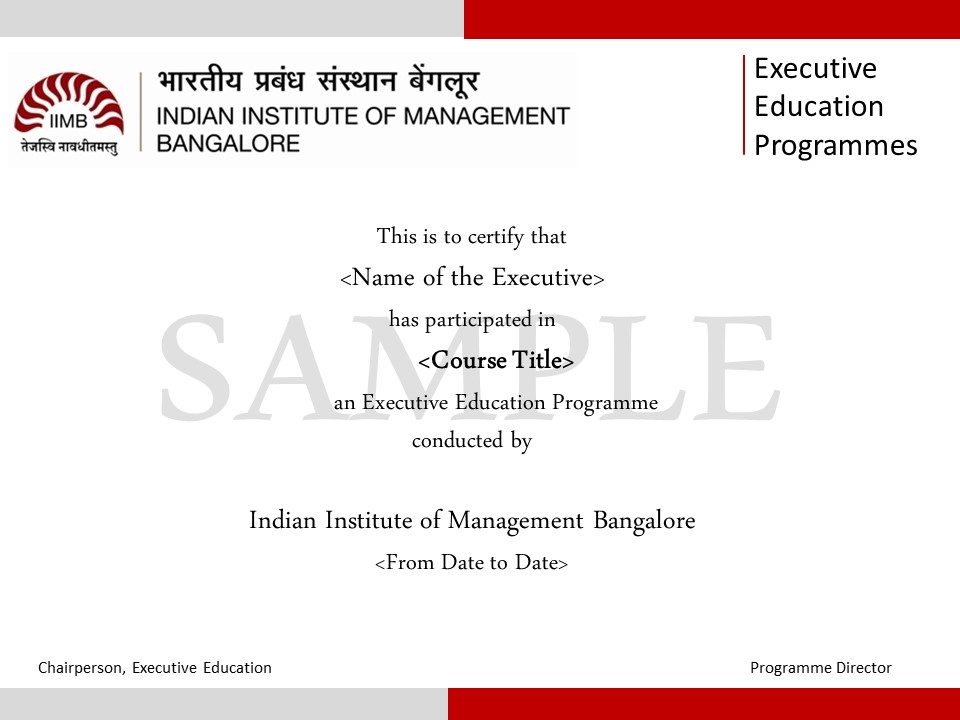
Note: Certificate image is for reference to potential participants only and may change at the discretion of Executive Education Programmes Office