

|
Program Dates |
Register By Early Bird: 15 Dec, 2026 Regular: 26 Dec, 2026 |
Pricing (Residential) Early Bird: Rs.1,09,800+GST Regular: Rs.1,22,000+GST |
Pricing (Non-Residential) Early Bird: Rs.90,000+GST Regular: Rs.1,00,000+GST |
Apply Now |
Mr. Kumar Amit Akash
Mobile No. +91-89512 81603
Email: kumar.amitakash@iimb.ac.in
The programme is designed for executives and professionals with an analytical mindset who wish to apply quantitative methods for forecasting and business decision-making.
Although the programme begins with a review of essential statistical concepts, participants will benefit from having:
Hands-on experience with forecasting techniques is not required.
Participants are encouraged to bring their own forecasting datasets and business problems. Those who do not have suitable datasets will be provided with realistic datasets during the programme.
Programme Overview
With increasing complexity, competition, and rapid changes in today’s business environment, organisations are relying more than ever on predictive analytics to support evidence-based decision-making. The growing availability of data, coupled with advances in analytical techniques, has significantly enhanced the role of forecasting across business functions.
This programme provides a comprehensive overview of modern forecasting methods and predictive analytics techniques used for managerial decision-making. Participants will learn to address a wide range of business forecasting problems, including demand forecasting, market size estimation, sales projections, customer behaviour analysis, and stock price prediction.
The programme covers both regression-based and time-series forecasting techniques through a balanced combination of conceptual discussions, case studies, hands-on numerical demonstrations, and software-based implementation using R and SPSS. The emphasis throughout is on enabling participants to apply these techniques effectively to solve real business forecasting problems.
Software
The programme primarily uses R, a powerful, free, and open-source statistical software widely used by industry and academia. Prior experience with R is beneficial but not mandatory.
Participants will receive introductory learning material approximately one week before the programme to help them become familiar with R. During the programme, faculty and teaching assistants will provide guidance on the required coding. Participants who prefer not to write code may implement many of the techniques, although with some limitations, using SPSS.
Hands-on Project
A distinctive feature of the programme is its strong emphasis on experiential learning. Participants will work in small groups on predictive analytics and forecasting projects using either:
A significant portion of the programme is devoted to project work, enabling participants to apply the concepts and techniques learned in class.
Programme Contents:
Key Benefits and Learning Outcomes
On successful completion of the programme, participants will be able to:

Shubhabrata Das
Professor, Decision Sciences
Chairperson, Admissions and Financial Aid
Member, National Statistical Commission, MoSPI
PhD, University of North Carlina at Chapel Hill, USA
M Stat, B Stat, Indian Statistical Institute, India
Professor Shubhabrata Das has been a faculty at IIMB since December 1999. He has held visiting faculty positions at various institutes/universities of international repute, including ESSEC Business School, Indian Statistical Institute Calcutta, University of Nebraska, and University of Montana.
His broad research domain is Statistics, Actuarial Mathematics and Operations Research. He has active interest and experience in aptitude testing, market research and analytics, sports analytics and governance, logistics, business forecasting, insurance analytics, statistical analysis of fuzzy data, measurement and scaling problems, health and education. He has published several papers in journals of international repute. He is a coauthor of a book titled, ‘Facing the Future: Indian Pension Systems’. He is also the co-author of the chapter on canonical correlations in the Encyclopedia of Biostatistics. Besides these, he has published several technical reports and delivered seminars at various international conferences and academic institutes of repute across the globe. His co-authored book titled Business Data Analytics: From Data to Decisions, by University Press is expected to be released in 2025.
He has engaged in training and other consultancy services in the domain of Market Research, Business Statistics, Business Analytics, Business Forecasting various leading market research firms, government organisations as well as other prominent companies in the country.
Participant Benefits
As a participant of this Short Duration Programme, you will be able to enjoy some exclusive benefits other than the outcomes such as skills and knowledge enhancement and building specific competencies that can help shape your career growth.
Some of the exclusive benefits of attending this programme are listed below –
Programme Fee
INR 1,22,000/- Residential and INR 1,00,000/- Non -Residential (+ Applicable GST) per person for participants from India and its equivalent in US Dollars for participants from other countries.
Early Bird Discount
Nominations received with payments on or before 15-Dec-26 will be entitled to an early bird Discount of 10%.
Early Bird Fee (Residential) INR 1,09,800/-(+ Applicable GST)
Early Bird Fee (Non-Residential) INR 90,000/-(+ Applicable GST)
Group Discount
Group Discount of 5% percentage can be availed for a group of 3 or more participants when nominations received from the same organization.
Please Note
All enrolments are subject to review and approval by the programme director. Joining Instructions will be sent to the selected candidates 10 days prior the start of the programme.
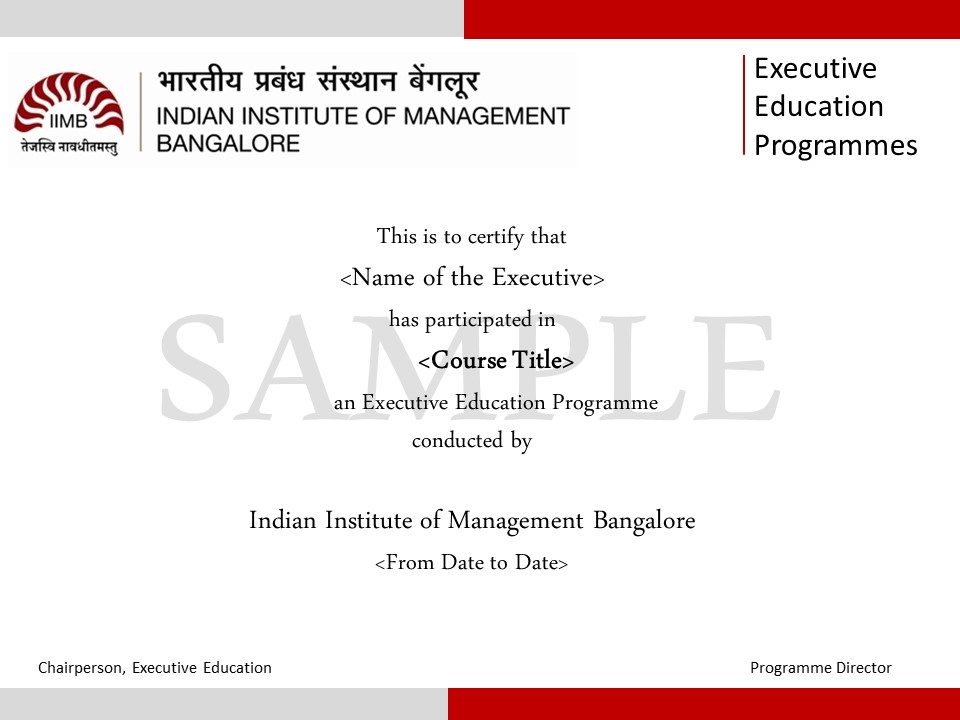
Note: Certificate image is for reference to potential participants only and may change at the discretion of Executive Education Programmes Office